

In September, we counted the drafts sitting in our clients’ WordPress queues. The dashboard said 122. When we opened the pile and sorted every item, about 13 were real articles. The rest were duplicates and feeds pointed at the wrong site.
That is the kind of lesson AI marketing courses leave out. So we built a free AI marketing training from our own work instead: six short lessons for small business owners, each one a full article you can read right now. No signup. No upsell wall.
Part 1 shows you how to put AI to work without losing control of your brand. Part 2 shows you where your marketing budget quietly leaks, and how to plug it.
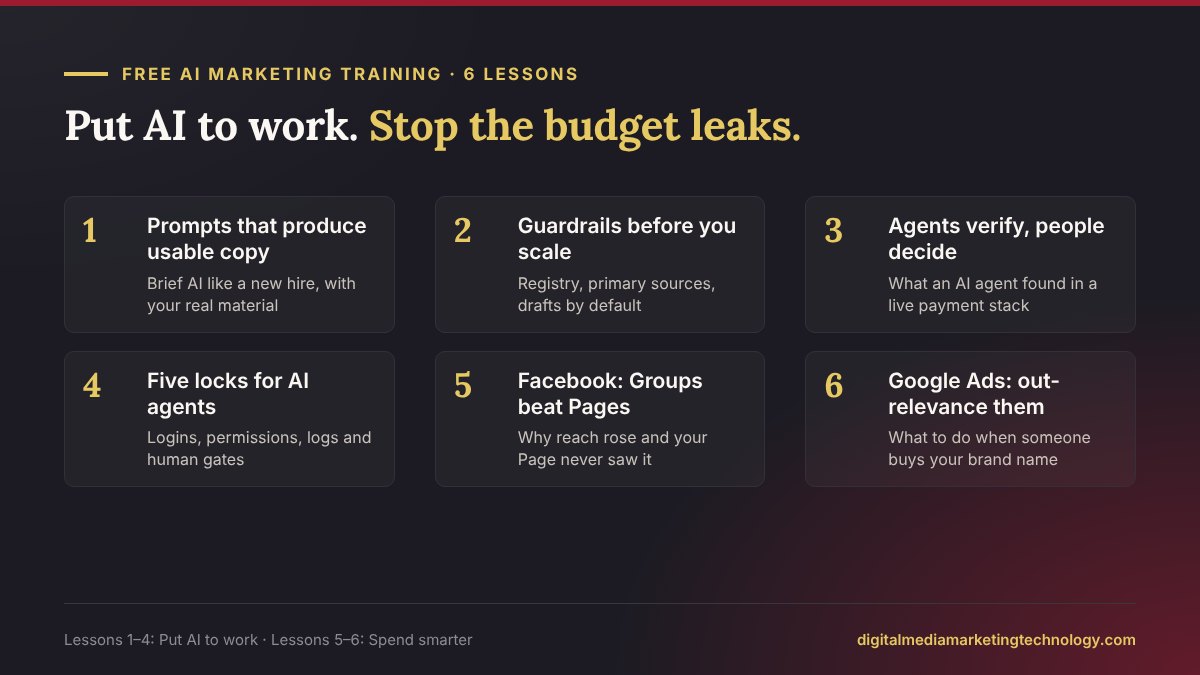
What this free AI marketing training covers
Read the lessons in order, or jump straight to the problem you have today.
- Lesson 1: Write AI prompts that produce usable marketing copy
- Lesson 2: Set guardrails before you scale AI content
- Lesson 3: Let AI agents verify while people decide
- Lesson 4: Add five locks before an AI agent gets your keys
- Lesson 5: Find out why your Facebook Page stopped reaching people
- Lesson 6: Defend your brand name in Google Ads without a bidding war
Part 1: Put AI to work without losing control
Lesson 1: Write AI prompts that produce usable marketing copy
Most bad AI copy starts with a bad brief. Treat the model like a specific team member, such as a copywriter, an analyst or a social media strategist, and give it the details a new hire would need.
The lesson includes 10 copy-and-adapt prompts, from a weekly content calendar to a landing page diagnostic. Three habits matter more than any single prompt:
- Feed it your real material. Actual reviews, actual page copy, actual customer emails.
- Say what you are optimizing for. Phone calls, form fills or bookings.
- Make it show its reasoning on anything you publish, and check every fact before it goes live.
Take the lesson: 10 AI prompts every small business owner should use to automate marketing
Lesson 2: Set guardrails before you scale AI content
Speed is no longer the hard part. Accuracy is. Over 40 days of building with Claude, our team published 10 new pieces on four client sites that had gone quiet. Three rules did more than any prompt.

- Load a client registry first. Exact business name, phone, service areas and compliance limits, before anything gets written.
- Check every claim against its source. Statutes, deadlines and percentages get verified, then cited.
- Make draft the default. A person approves what goes live.
The other lesson: count what is actually in your queue. A dashboard tells you how big the pile is. It does not tell you what is in it.
Take the lesson: 40 days of building with Claude, and what we found when we counted the drafts
Lesson 3: Let AI agents verify while people decide
An AI agent can do real operations work. The question is which parts it should own.
When an agency pointed Claude at its own live WooCommerce store, the agent read sales-tax rules in three states before touching a setting. It pulled the store’s stored configuration instead of trusting the dashboard. It traced an Apple Pay error to a one-domain limit, and it caught service products set to charge tax they should not charge.

It did not pick the payment gateway or decide to test with real money. It laid out the tradeoffs and handed those calls back to people. That boundary is the benchmark: verification scales, judgment stays human.
Take the lesson: An AI agent audited a live payment stack and found a bug nobody saw
Lesson 4: Add five locks before an AI agent gets your keys
AI agents do not need bad intentions to cause an expensive week. They need a goal, your logins and a system with a soft spot. Before you connect an agent to your booking system, CRM or website, add five locks:
- Audit anywhere one user can change another user’s records.
- Give every agent its own login with the fewest permissions possible.
- Log every action an agent takes, with a time and a named actor.
- Require a person to approve anything that touches a customer or the public.
- Rate-limit forms, promo code fields and inventory endpoints.
Take the lesson: Your AI agent will break the rules to finish the job
Part 2: Stop paying for marketing that reaches no one
Lesson 5: Find out why your Facebook Page stopped reaching people
Facebook reach rose 51% year over year in Metricool’s 2026 study of nearly 40 million posts. If you run a small business Page, you almost certainly did not feel it.
Socialinsider’s benchmarks put the average Facebook engagement rate at 0.15%. Link posts averaged 0.05%, the weakest format measured. Bare links are exactly what most local business Pages post.

The fix is not a bigger boost budget. Find the local Groups where customers already ask for what you sell. Answer questions as a person, not a logo. Write the substance into your posts instead of linking out.
Take the lesson: Facebook reach went up last year. Your business Page never saw it.
Lesson 6: Defend your brand name in Google Ads without a bidding war
When a reseller runs Google Ads on your company name, the instinct is to outbid them. That usually makes both of you pay more.
Ad position depends on Ad Rank, not bid alone. The brand owner already holds the most relevant landing page for its own name. Fix your landing page and sitelinks before you raise a single bid.

Then run four checks: search your brand while signed out, look up the advertiser in Google’s Ads Transparency Center, pull Auction Insights by ad group, and replace sitelinks that point to “Home” or “Contact Us.”
Take the lesson: Someone is buying ads on your brand name. Outbidding them is the wrong move.
How do you use AI for marketing without hurting your brand?
Across all six lessons, the same five rules keep showing up:
- Give AI real inputs. Generic prompts produce generic copy.
- Verify before you publish. A model states a wrong number with the same confidence as a right one.
- Keep a person on the last gate for content, payments and anything customers see.
- Limit what AI tools can touch. Separate logins, minimum permissions, full logs.
- Measure money, not activity. Calls, form fills and bookings beat likes and impressions.
Google draws the same line. Its guidance says generative AI can help with research and structure, but using it to generate many pages without adding value for users may violate its spam policy on scaled content abuse.
Free tools to see where your marketing stands
MCNM Marketing, the team that publishes this site, built these free tools for small business owners:
- Free Local SEO Checkup: 12 questions, about two minutes. It scores your Google Business Profile, reviews, website, tracking and lead follow-up, then shows your biggest gap.
- Missed Call Calculator: enter your call volume and average job value to see what unanswered calls cost you each month.
- Free Marketing Audit: a review of your website, Google Business Profile and rankings, with a prioritized 90-day plan.
- The Biblical Business Blueprint: a free course for Christian business owners, with a new lesson every Wednesday.
If missed calls are your biggest leak, MCNM’s AI marketing agents answer calls, reply to texts and chats, request reviews and book appointments around the clock, with a human handoff built in.
Frequently asked questions
Is this AI marketing training really free?
Yes. All six lessons are free articles on this site, with no signup and no paywall. The MCNM Marketing tools listed above are free too. If you want help applying a lesson to your own business, a free marketing audit is available, but you never need it to use the training.
Do I need technical skills to use AI for marketing?
No. Lessons 1, 5 and 6 need nothing more than a browser and an AI assistant. Lessons 2, 3 and 4 matter once you connect AI tools to your website, CRM or booking system. That is the point where logins, permissions and review steps start to matter more than prompts.
Which AI tool should a small business start with?
Start with the AI assistant you already have. The prompts in Lesson 1 work in any major chat assistant because the results depend on your inputs: real reviews, real page copy and a clear goal. Choose a paid tool only after you know which marketing job you need done.
Will AI-written content hurt my Google rankings?
Not because AI helped write it. Google’s guidance says generative AI can help with research and structure, but using it to churn out many pages without adding value may violate its scaled content abuse policy. Accurate, original and helpful content is the standard, however it was drafted.
How long does AI marketing take to show results?
Faster production shows up right away. Rankings do not. In our experience, new pages on a smaller site usually need several months to settle into stable positions. Track calls, form fills and bookings each month, and judge every lesson by the leads it produces, not the content it creates.
Is AI marketing worth it for a small business? Pros and cons
MCNM’s take: We use AI tools in our own work, including Claude, HighLevel’s AI Employee and ElevenLabs. Our rule: AI can draft, but a person reviews and approves before anything publishes or sends. Some of these lessons came from gaps in that rule, like our own news aggregator publishing without review.
Pros
- AI speeds up first drafts of posts, emails and ad copy, so a small team can publish on a steady schedule.
- You can start with the AI assistant you already have. Results depend more on your inputs than on the tool.
- AI agents are good at checking work, like reading store settings and tax rules before anyone changes them.
Cons
- AI states wrong facts with full confidence, so a person must check every claim before it goes live.
- Cheap volume hides problems. Our dashboard showed 122 drafts, and only about 13 were real articles.
- Connecting AI to your website, CRM or booking system adds risk unless each tool gets its own limited login.
Our recommendation: AI marketing makes sense for owners who will feed it real inputs and keep a person on the final check. If no one on your team has time to review what AI produces, start smaller or wait. This week, pick one task, such as your weekly social post, and let AI draft it while you approve every word.
Your turn: What is one thing an AI tool got wrong in your marketing that you only caught after it was already published? Tell us in the comments below.
Want these lessons applied to your business?
MCNM Marketing, the team behind this publication, helps businesses across Las Vegas, Southern California and Northern Arizona put AI to work with AI marketing agents, local SEO and marketing automation. Start with a free audit and a 90-day plan you can actually run.
Disclosure: Digital Media Marketing & Technology News is published by MCNM Marketing. The tools and services linked above are MCNM’s own. Lesson 3 describes a session on MCNM’s own store; nothing in this training is tax or legal advice.
Put AI to Work for Your Business
MCNM Marketing — the team behind this publication — helps businesses across Las Vegas, Southern California, and Northern Arizona turn stories like this into revenue with AI marketing solutions, SEO & digital strategy, and marketing automation. A+ BBB rated.
Discover more from Digital Media Marketing, and Technology News
Subscribe to get the latest posts sent to your email.